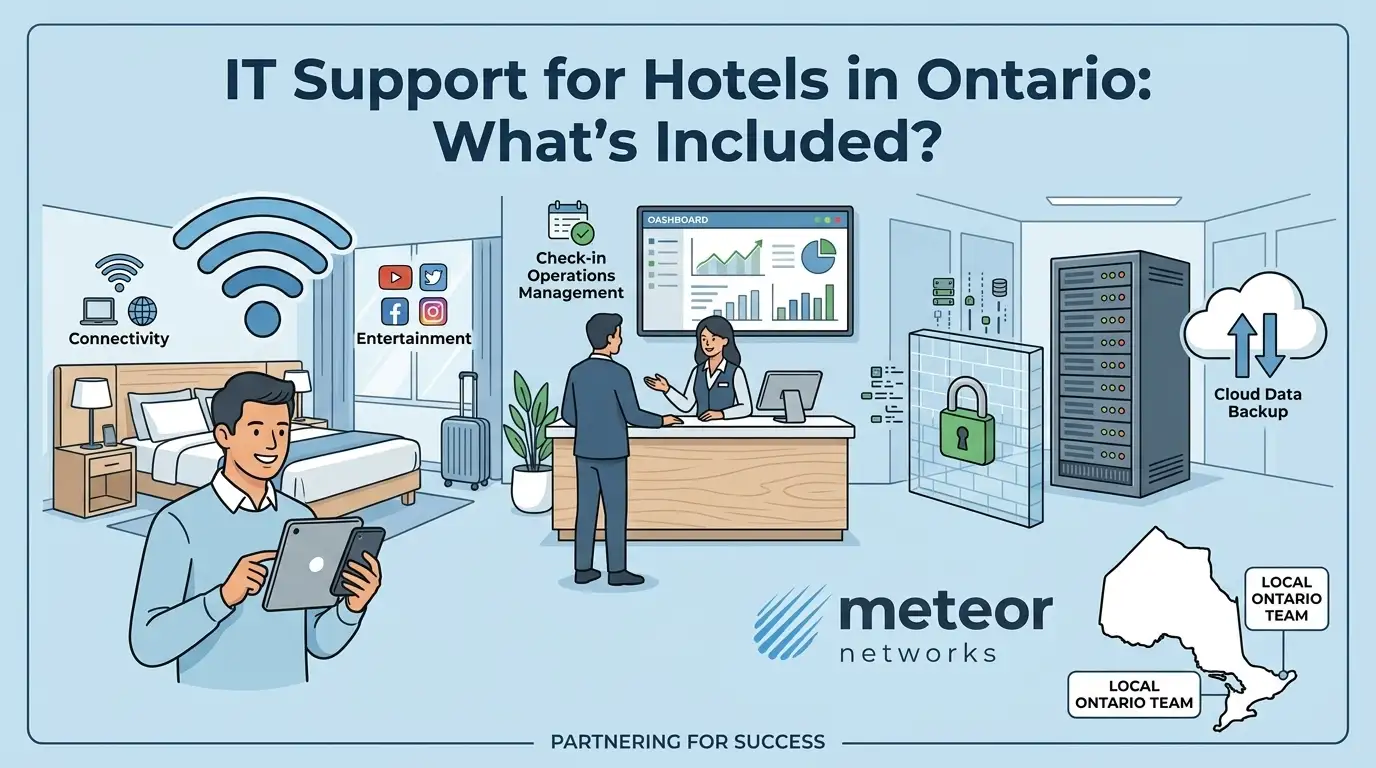
Hotels depend on technology around the clock. Reservations, check-ins, payment terminals, guest Wi-Fi, phones, security cameras, staff accounts, and back-office systems all need to work together.
Hotel IT support manages the infrastructure behind these services. Depending on the agreement, it may include 24/7 monitoring, helpdesk support, network management, cybersecurity, backups, Microsoft 365, phone systems, structured cabling, vendor coordination, and technology planning.
The exact scope varies by provider. Hotels should confirm what is covered, when support is available, and which systems remain the responsibility of third-party vendors.
What Does Hotel IT Support Include?
1. IT Helpdesk and On-Site Support
IT Helpdesk and On-Site Support
Hotel employees need a clear point of contact when technology fails. The IT helpdesk may assist with:
- Front-desk workstation and printer problems
- Staff login and password issues
- Microsoft 365 applications and email
- Payment-terminal connectivity
- Network and internet problems
- Shared drives and file access
- New employee setup and departing employee access removal
- Remote troubleshooting and on-site service
Coverage should reflect hotel operating hours. A provider offering only weekday support may not be suitable if a network, front-desk computer, or phone system fails overnight.
Ask whether the agreement includes 24/7 response or only 24/7 monitoring. These are not the same: monitoring can detect a problem at any time, while response coverage determines when a technician will act.
2. Network and Internet Management
Network and Internet Management
A hotel network connects operational systems, employee devices, payment terminals, phones, cameras, access points, and guest services. IT support typically covers:
- Firewalls, switches, routers, and wireless access points
- Internet connection monitoring
- Network performance and capacity
- Secure remote access
- Firmware and configuration updates
- Separate networks for guests, staff, payments, cameras, and building systems
- Coordination with internet service providers
- Backup internet or automatic failover, when required
Network segmentation is particularly important. Guests should not be able to reach hotel administration, payment, property management, or security systems through the guest network.
3. Guest Wi-Fi
Guest Wi-Fi
Guests expect reliable Wi-Fi in rooms, lobbies, meeting spaces, restaurants, and other common areas. Hotel Wi-Fi support may include:
- Wireless site surveys
- Access-point placement and configuration
- Coverage and capacity planning
- Guest portals and acceptable-use settings
- Bandwidth management
- Network isolation
- Performance monitoring
- Troubleshooting weak coverage, congestion, and dropped connections
Coverage alone is not enough. The network must also handle the number of guests and devices expected during conferences, weddings, full occupancy, or seasonal peaks.
The provider should explain whether it supports only the network equipment or also assists guests with connection problems.
4. Property Management and Reservation System Infrastructure
Property Management and Reservation System Infrastructure
The property management system, or PMS, supports reservations, room status, check-in, billing, and other front-desk processes. An IT provider may support:
- Computers, servers, and network connections used by the PMS
- Secure access for authorized staff
- Connections to printers, payment systems, and other integrations
- Software deployment requirements
- System availability monitoring
- Coordination with the PMS or reservation-platform vendor
Most managed IT providers do not control the PMS application itself. When an incident involves both the application and the local network, the IT provider should work directly with the software vendor instead of leaving hotel staff to coordinate the investigation.
The same approach applies to point-of-sale systems, booking engines, door-access platforms, IPTV, room controls, and other hospitality applications.
5. Cybersecurity and Guest Data Protection
Cybersecurity and Guest Data Protection
Hotels hold valuable personal and operational information, including guest contact details, reservation records, staff accounts, and payment-related data. Cybersecurity services may include:
- Managed endpoint protection
- Email filtering and anti-phishing controls
- Multi-factor authentication
- Microsoft 365 security configuration
- Firewall management
- Security monitoring and alert response
- Vulnerability and patch management
- Staff security awareness training
- Account and access reviews
- Incident-response planning
PIPEDA applies to private-sector organizations that collect, use, or disclose personal information during commercial activities. Appropriate safeguards should be based on the sensitivity of the information.
Organizations subject to PIPEDA must also keep records of every breach involving personal information under their control. Breaches that create a real risk of significant harm must be reported to the Privacy Commissioner of Canada, and affected individuals must be notified.
An IT provider can implement safeguards, maintain technical records, and assist during an incident. However, the hotel remains responsible for its legal and privacy obligations.
Hotels that accept payment cards must also consider PCI DSS. IT support can help reduce the payment environment’s exposure through network segmentation, access controls, patching, monitoring, and secure configurations. It should not be described as a guarantee of compliance unless the provider is specifically engaged and qualified to perform the required assessment.
6. Microsoft 365 and Staff Account Management
Microsoft 365 and Staff Account Management
Hotels commonly use Microsoft 365 for email, documents, scheduling, communication, and collaboration. Support may cover:
- User account and licence management
- Exchange Online and email configuration
- Teams, SharePoint, and OneDrive
- Multi-factor authentication
- Email security
- Mobile-device access
- Shared mailboxes and distribution lists
- File permissions
- Employee onboarding and offboarding
- Microsoft 365 backup, if included separately
Fast offboarding matters in an industry with seasonal staffing and frequent role changes. When an employee leaves, access to email, shared files, administrative systems, and hotel data should be removed promptly.
Microsoft’s native retention and recovery features do not replace every backup requirement. Hotels should confirm whether independent Microsoft 365 backup is included, what data it protects, and how long backups are retained.
7. Backup and Disaster Recovery
Backup and Disaster Recovery
A backup is useful only if the hotel can restore the required data and systems within an acceptable timeframe. Hotel IT support may include:
- Server and workstation backups
- Microsoft 365 backup
- Encrypted off-site or cloud copies
- Backup monitoring
- Restore testing
- Documented recovery procedures
- Recovery time and recovery point targets
- Disaster-recovery planning
The recovery plan should identify which systems must return first. Front-desk operations, reservations, phones, payment connectivity, and management communications may take priority over less critical services.
Hotels should ask how operations would continue during ransomware, a server failure, an internet outage, or extended power loss.
8. Business Phones and Guest Communications
Business Phones and Guest Communications
Hotels require phone service at reception, guest rooms, administrative offices, conference facilities, and service areas. Support may include:
- Cloud, on-premises, or hybrid phone systems
- Front-desk and administrative phones
- Guest-room extensions
- Auto attendants and call routing
- Voicemail
- Emergency calling configuration
- Call queues
- Mobile and desktop calling applications
- Paging and intercom systems
- Carrier coordination
The hotel should confirm responsibility for guest-room phones, elevator or emergency lines, fax services, and legacy analogue devices. These may require specialized connections or separate vendors.
9. Structured Cabling and Technology Projects
Structured Cabling and Technology Projects
New access points, cameras, phones, workstations, and hotel systems require reliable cabling. Services may include:
- Copper and fibre cabling
- Data-jack installation
- Network-rack organization
- Cable testing and labelling
- Wireless access-point cabling
- Phone and camera cabling
- Renovation and expansion planning
For renovations or new properties, the IT provider should be involved before construction is complete. Early planning helps prevent poor access-point placement, insufficient network capacity, missing cable runs, and costly rework.
10. Vendor Management and IT Planning
Vendor Management and IT Planning
Hotels often work with separate vendors for internet, PMS, POS, payment processing, phones, cameras, electronic locks, booking systems, and guest entertainment. A managed IT provider can act as the technical point of contact by:
- Maintaining a current inventory of systems and vendors
- Documenting network and account information
- Opening and managing support cases
- Identifying whether a problem involves the network, device, or application
- Coordinating upgrades and integrations
- Reviewing contracts and renewal requirements
- Planning replacements and technology budgets
This reduces time spent passing between vendors when no one accepts responsibility for an issue.
What May Not Be Included?
Do not assume every managed IT agreement includes:
- Guest helpdesk support
- Internal support for the PMS, POS, or booking application
- Payment compliance assessments
- Cybersecurity monitoring outside business hours
- Microsoft 365 backup
- Cabling and installation projects
- Replacement hardware
- Internet or phone carrier fees
- Support for room controls, smart locks, IPTV, or building automation
- After-hours on-site visits
These services may be available but billed separately. The agreement should define covered users, devices, locations, systems, hours, response targets, project rates, and escalation procedures.
Questions to Ask a Hotel IT Provider
Before choosing a provider, ask:
- Is live technical support available 24/7, or is only monitoring continuous?
- Which systems receive priority during a critical incident?
- Are guest, staff, payment, camera, and building-system networks separated?
- Who supports the PMS and coordinates with its vendor?
- Is Microsoft 365 backup included?
- How often are backups tested?
- What happens if the primary internet connection fails?
- Are cybersecurity monitoring and incident response included?
- What work is considered a separately billed project?
- Can the provider support every Ontario location under one agreement?
The answers should be documented in the contract, not left as verbal expectations.
IT Support Built Around Hotel Operations
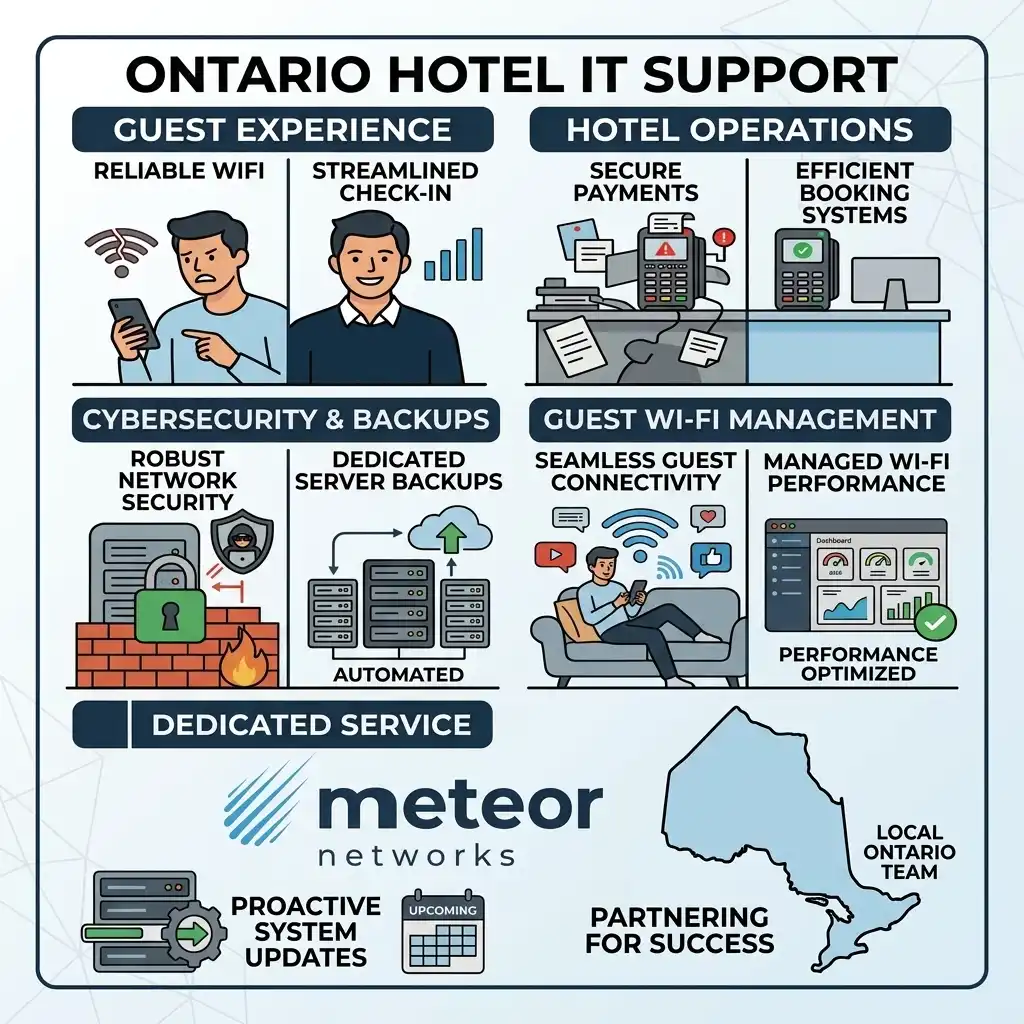
Effective hotel IT support covers more than office computers. It protects the systems required to accept reservations, check in guests, process payments, communicate with staff, and provide reliable connectivity throughout the property.
Meteor Networks supports Ontario hotels with managed IT services, cybersecurity, Microsoft 365, business phone systems, network infrastructure, structured cabling, backup planning, and vendor coordination. We assess the existing environment, identify coverage and security gaps, and define exactly what your support plan includes.
Talk to Meteor Networks about IT support for your hotel or hospitality group.