
A general IT provider may keep computers running. A healthcare IT partner must understand how technology affects appointments, patient records, communication, billing, and care delivery.
Healthcare providers need an IT partner that understands clinical workflows, protects patient information, keeps critical systems available, supports PHIPA obligations, responds quickly, tests backups, and coordinates vendors. The right partner reduces risk and prevents technology problems from disrupting patient care.
Meteor Networks provides healthcare-focused IT support, cybersecurity, backup planning, and vendor coordination for Ontario providers. We keep technology secure, reliable, and ready to support patient care.
Technology That Supports Patient Care
Clinical and administrative teams rely on electronic medical records, scheduling platforms, diagnostic systems, secure communication tools, Microsoft 365, internet access, and connected devices.
When these systems fail, the effects reach beyond office productivity. Staff may lose access to patient information, appointments may be delayed, and clinicians may have to use slower manual processes.
An IT partner should understand which systems are critical, how they connect, and how quickly each one must be restored. Support priorities should reflect the effect on care, not simply the order in which tickets arrive.
Privacy and Security Built Into IT Management
Ontario healthcare organizations must protect personal health information under the Personal Health Information Protection Act (PHIPA). These responsibilities remain with the healthcare provider even when technology or data processing is handled by a third party. The Information and Privacy Commissioner of Ontario has specifically warned that custodians must ensure patient information remains protected when service providers are involved.
An IT partner should help establish and maintain:
- Role-based access to patient and business systems
- Multi-factor authentication
- Secure device and account configurations
- Encryption where appropriate
- Audit logging and access monitoring
- Timely software and security updates
- Staff security awareness training
- Documented access removal when employees leave
- Incident response and breach escalation procedures
Technology can support privacy compliance, but no provider should promise that a product or service makes an organization automatically compliant. Compliance also depends on policies, staff practices, consent, information handling, and organizational oversight.
Cybersecurity That Addresses Healthcare Risks
Healthcare organizations hold sensitive information and depend on uninterrupted access to their systems. That makes them attractive targets for phishing, account theft, ransomware, and data extortion.
The Canadian Centre for Cyber Security warns that ransomware can stop critical processes and prevent access to patient information. Protection therefore requires more than antivirus software.
A healthcare IT partner should use layered controls, including:
- Email filtering and phishing protection
- Endpoint detection and response
- Multi-factor authentication
- Managed firewalls and network security
- Vulnerability and patch management
- Restricted administrative privileges
- Secure remote access
- Backup monitoring
- Security event investigation
- A documented response plan
The partner should also explain what is protected, what remains at risk, and what actions will be taken if suspicious activity is detected.
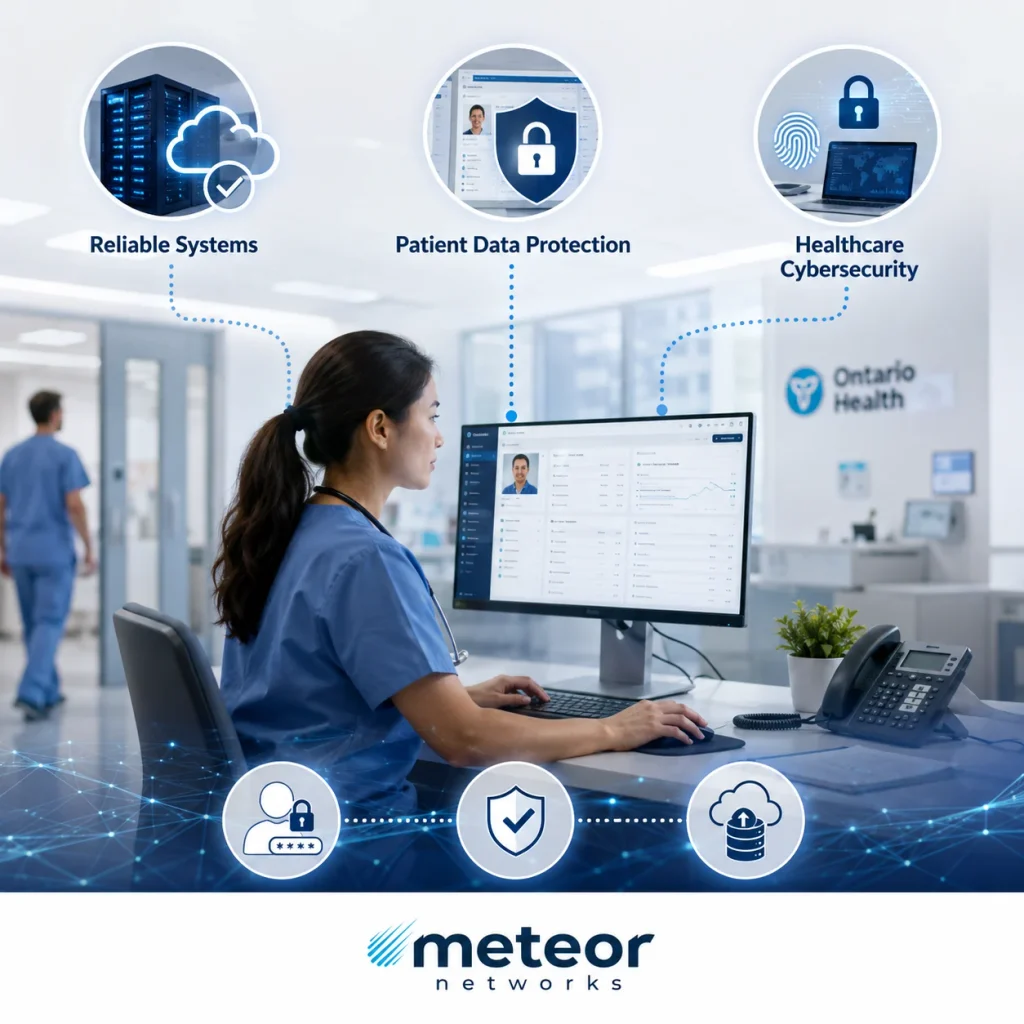
Reliable Systems and Tested Recovery
A backup is useful only if it contains the required data, is protected from the incident affecting the main system, and can be restored within an acceptable period.
Healthcare providers need a documented recovery plan that identifies:
- Which systems must be restored first
- How much data loss is acceptable
- How long recovery may take
- Where backups are stored
- How backups are protected
- How often restoration is tested
- How staff will work during an outage
- Who is responsible for recovery decisions
The plan should cover cyberattacks, equipment failure, internet outages, power disruptions, software problems, and facility-level incidents. It should also provide alternatives for critical communication and clinical workflows.
Responsive Support With Clear Priorities
Healthcare staff should not have to explain the operational importance of the same systems every time they request help.
The IT partner should have:
- Defined support hours
- Clear response and escalation targets
- Priority handling for care-affecting incidents
- Remote and on-site support options
- Documented systems and procedures
- A process for recurring problem analysis
- Communication during major incidents
Fast acknowledgement is not the same as fast resolution. Providers should review how the IT company measures response time, resolution time, recurring issues, and user satisfaction.
Support for Healthcare Applications and Vendors
Medical practices often depend on several technology vendors, including EMR providers, internet carriers, phone companies, imaging platforms, payment processors, and medical device suppliers. Problems can stall when each vendor claims another system is responsible.
A capable IT partner should coordinate these vendors, gather technical evidence, manage escalations, and remain involved until the issue is resolved. This gives clinic managers one accountable point of contact without expecting the IT provider to replace specialized application support.
Before hiring a provider, confirm its experience with your existing platforms and its process for working with third-party vendors.
A Practical Technology Plan
Healthcare IT should not be managed only when something fails. The organization needs a plan covering security risks, aging equipment, licensing, cloud services, growth, compliance priorities, and upcoming projects.
A useful IT plan should identify:
- Current risks and their business impact
- Recommended actions in priority order
- Expected costs and timelines
- Equipment replacement schedules
- Security and recovery improvements
- Technology requirements for new locations or services
- Progress against agreed goals
Recommendations should be based on operational need and risk. Pricing, contract terms, licensing, and project exclusions should be clear before work begins.
Questions to Ask a Potential Healthcare IT Partner
Use these questions during vendor evaluations:
- What experience do you have supporting medical clinics or healthcare organizations?
- How do you protect personal health information?
- What happens when an incident affects patient care?
- How do you monitor and respond to security threats?
- How often are backups tested through actual restoration?
- How do you support our EMR and other specialized vendors?
- What response and escalation targets are included in the agreement?
- How will you document our systems, accounts, and recovery procedures?
- How do you report risks, recurring problems, and completed work?
- What support will we receive during a cyber incident or major outage?
- How do you control your own technicians’ access to our environment?
- How will our data, documentation, and access be transferred if the relationship ends?
Specific answers are more valuable than broad claims about service, security, or compliance.
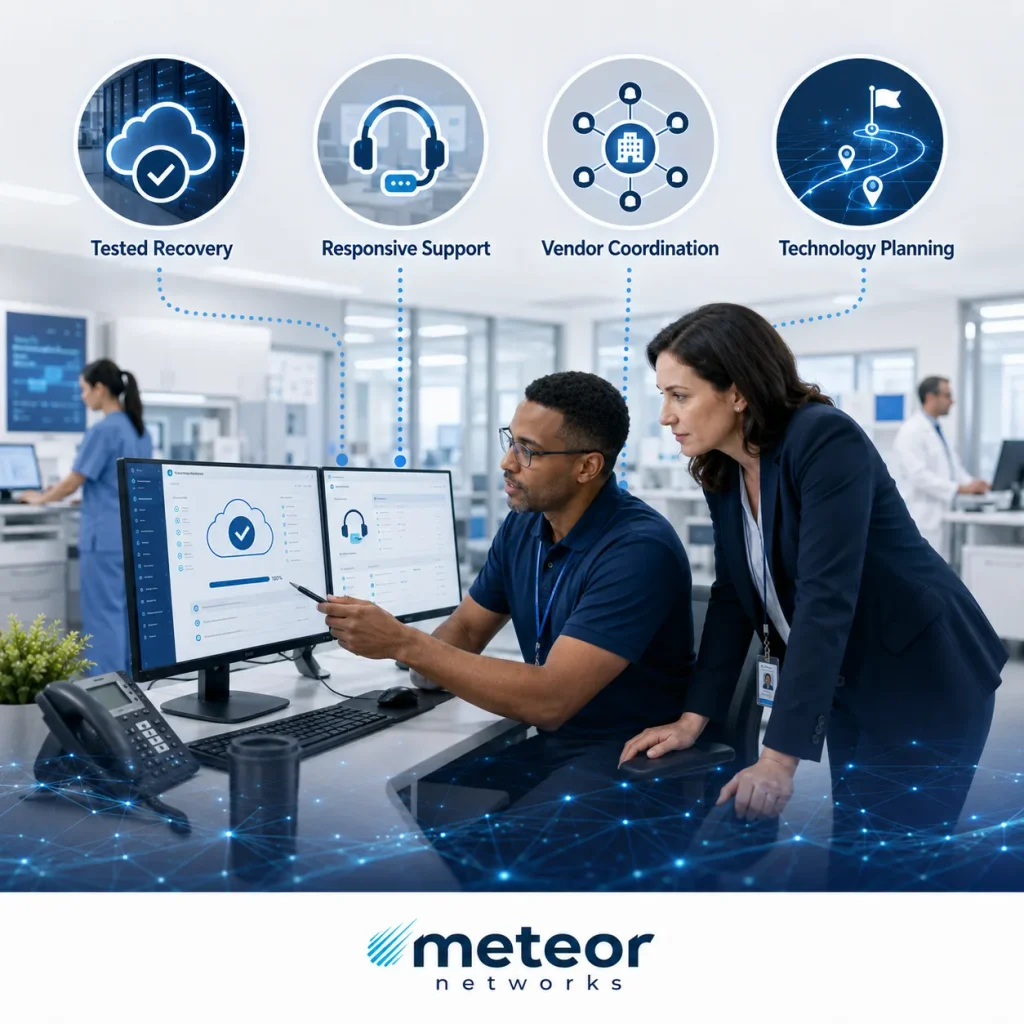
Warning Signs When Choosing an IT Partner
Be cautious if a provider:
- Claims its services automatically make your organization PHIPA compliant
- Cannot explain how backups are tested
- Uses shared administrator accounts
- Provides no written incident escalation process
- Treats every support request with the same priority
- Offers unclear pricing or service boundaries
- Cannot describe how it protects its own remote access
- Has no process for removing former staff access
- Recommends products without assessing clinical workflows
- Provides little documentation or reporting
Healthcare providers should know who can access their systems, how that access is controlled, and what happens during an emergency.
Healthcare IT Support From Meteor Networks
Meteor Networks helps Ontario healthcare providers protect patient information, reduce disruptions, and manage essential technology. Our services cover managed IT support, cybersecurity, Microsoft 365, backup and continuity planning, business connectivity, phone systems, and technology vendor coordination.
We assess your current environment, identify priority risks, and create a practical plan based on your clinical operations and budget.
Schedule a discovery call to discuss your healthcare organization’s IT requirements.
Frequently Asked Questions
A healthcare IT partner understands the effect of technology on patient records, appointments, privacy, clinical workflows, and care delivery. Support and recovery priorities are based on operational impact.
No provider can guarantee compliance through technology alone. An IT partner can implement safeguards, document systems, and support privacy requirements, but the healthcare organization remains responsible for its policies and information practices.
Core protections include multi-factor authentication, email security, endpoint detection, patch management, secure backups, restricted administrative access, staff training, network protection, and an incident response plan.
Backups should be monitored continuously and restored on a scheduled basis to confirm that required data can be recovered. Testing frequency should reflect the importance of the system and the organization’s recovery requirements.
The partner should maintain the devices, network, security, access, and connectivity that support the EMR. It should also coordinate with the EMR vendor when application-specific assistance is required.