
The best phone system for an Ontario hotel is usually a hospitality-ready cloud or hybrid PBX, not a standard office VoIP platform.
The best phone systems for Ontario hotels are Mitel MiVoice and ClearlyIP ComXchange. Both support PMS integration, guest and front-desk calling, failover, emergency calling, mobile access, and centralized management. The right choice depends on your property’s size, infrastructure, and operational needs.
Hotels need more than basic calling and voicemail. The system must connect guest rooms, the front desk, reservations, housekeeping, maintenance, management, and emergency services while supporting modern and existing devices where practical.
Recommended Hotel Phone Systems: Mitel MiVoice and ClearlyIP ComXchange
Meteor Networks recommends Mitel MiVoice and ClearlyIP ComXchange for hotels in Ontario. Both systems support PMS integration, meet major hotel-brand requirements, and can be deployed for properties of different sizes.
Mitel MiVoice offers strong name recognition and a proven presence in the hospitality industry. It is a practical choice for hotels that prefer an established communications platform with broad industry adoption.
ClearlyIP ComXchange is built on a modern FreePBX foundation, providing greater flexibility in phone and device selection without locking the hotel into a single hardware vendor. It requires relatively few licences and is easier to administer, which can reduce operating complexity and ongoing costs.
Both platforms are trusted by and approved for use with major hotel brands, including:
- Choice Hotels
- Hilton
- Hyatt
- IHG
- Marriott
- Wyndham
What Type of Phone System Is Best for a Hotel?
Hotels generally choose from three options.
Cloud-Hosted PBX
A cloud PBX runs through a provider’s hosted infrastructure instead of relying on a complete phone system at the hotel.
It is often the best fit for:
- Boutique and mid-sized hotels
- Properties with dependable internet and network infrastructure
- Hotel groups that want centralized management
- Hotels replacing an aging PBX
- Staff who need mobile or desktop calling
Cloud systems reduce onsite hardware and make it easier to change extensions, routing rules, and users. However, the network, internet connection, power protection, and failover plan must be designed properly.
On-Premise PBX
An on-premise PBX is installed at the property and managed locally.
It may still be appropriate for:
- Large or full-service hotels with extensive existing infrastructure
- Properties with complex guest-room requirements
- Hotels that need greater local control
- Locations with limited or unreliable internet connectivity
The trade-off is greater responsibility for hardware, maintenance, upgrades, and replacement parts.
Hybrid Phone System
A hybrid system combines local equipment with cloud services, SIP trunking, or hosted features.
For many established Ontario hotels, this is the most practical migration path.
It can allow the property to modernize front-desk and administrative communications while retaining compatible guest-room phones or existing cabling.
This reduces the cost and disruption of replacing everything at once.
The Best Choice for Most Ontario Hotels
For many Ontario hotels, the strongest option is a managed cloud or hybrid phone system with:
| Verified PMS integration |
| Reliable guest-room and front-desk calling |
| Mobile access for authorized staff |
| Internet and power failover |
| Emergency-calling configuration |
| Centralized management |
| Local implementation and ongoing support |
A boutique hotel may benefit from a mostly cloud-based deployment. A larger property with existing analog phones or complex infrastructure may be better served by a phased hybrid migration.
The best system is not necessarily the one with the longest feature list. It is the one that fits the property, works with its hotel systems, survives common disruptions, and gives staff dependable access to support.

Essential Features in a Hotel Phone System
A hotel should evaluate the complete communication environment, not simply compare monthly prices per extension.
PMS Integration
PMS Integration
PMS integration can connect phone activity with guest records and room status. Depending on the systems involved, it may support:
- Guest check-in and checkout
- Guest-name display
- Room-status updates
- Wake-up calls
- Call permissions
- Call-charge tracking
- Voicemail reset between guests
Compatibility must be verified with the hotel’s specific PMS and integration method before a system is selected.
Reliable Front-Desk Call Handling
Reliable Front-Desk Call Handling
The front desk must manage reservations, guest requests, vendor calls, internal calls, and after-hours enquiries without unnecessary delays.
Useful features include:
- Auto-attendants
- Ring groups
- Call queues
- Overflow routing
- Time-based routing
- Voicemail-to-email
- Recorded announcements
- Mobile and desktop softphones
Routing should remain simple enough that callers can reach a person quickly.
Guest-Room Calling
Guest-Room Calling
Even when guests primarily use mobile phones, room phones still serve important purposes. They provide direct access to the front desk, housekeeping, hotel services, and emergency assistance.
Before replacing a system, confirm whether existing room phones, adapters, wiring, and emergency-call requirements can be retained or must be upgraded.
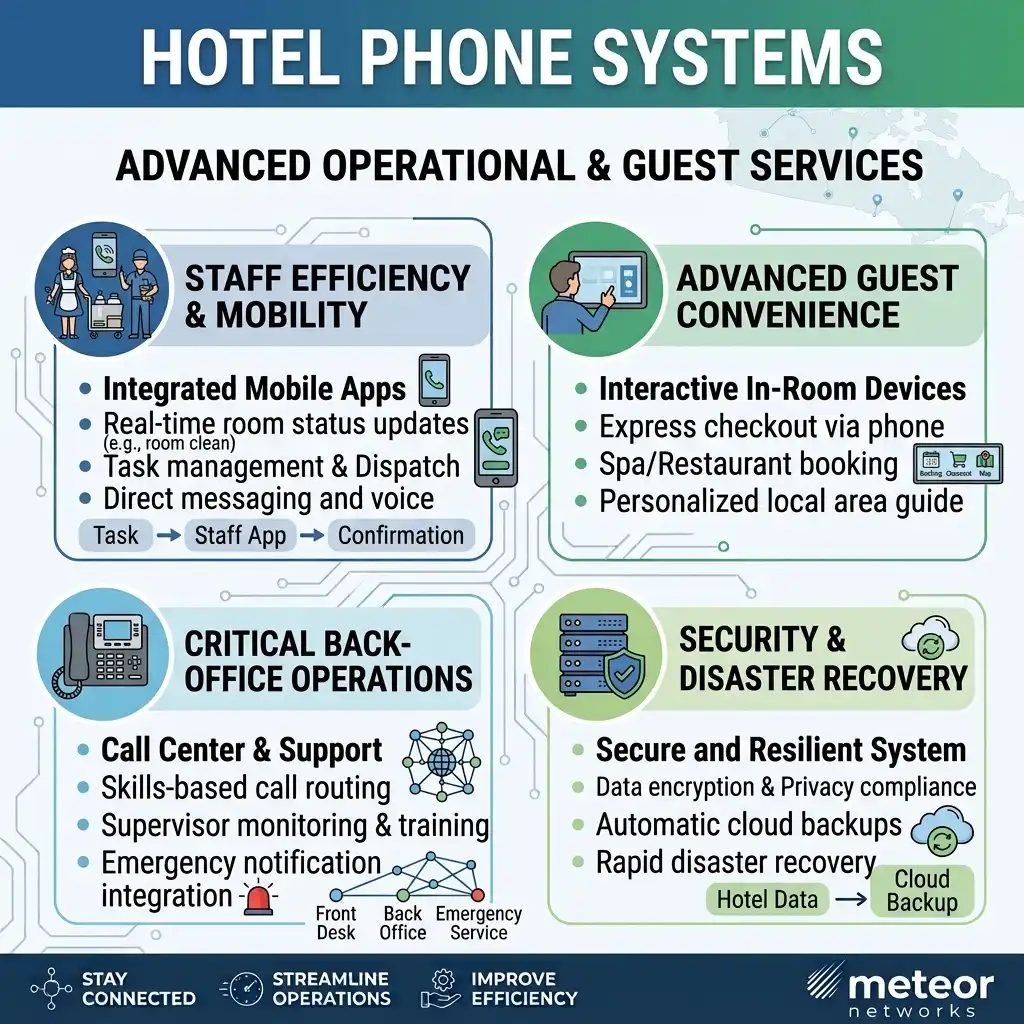
Staff Mobility
Staff Mobility
Hotel employees do not remain at desks. Mobile or cordless options help managers, maintenance teams, housekeeping supervisors, and other authorized staff respond while moving around the property.
A strong system should let appropriate employees receive hotel calls without exposing personal phone numbers.
Emergency Calling
Emergency Calling
Emergency calling must be addressed during design and testing, not after installation.
The configuration should support accurate location information, clear access to emergency services, and appropriate internal notifications. Multi-building hotels, large resorts, and properties with numerous room extensions require particular care.
Hotels should review the provider’s emergency-calling terms and keep location information current whenever devices or extensions move.
Network and Power Resilience
Network and Power Resilience
A cloud phone system is only as dependable as the infrastructure supporting it.
A hotel deployment may require:
- Business-grade internet
- A secondary internet connection
- Automatic connection failover
- Properly configured switches and voice networks
- Uninterruptible power supplies
- Redundant call routing
- Documented outage procedures
During an internet or local equipment failure, important calls may be redirected to another property, mobile device, reservations team, or answering service.
Centralized Multi-Property Management
Centralized Multi-Property Management
Hotel groups benefit from managing extensions, call routing, reporting, and administrative settings through one portal.
Centralized management can standardize the guest experience while still giving each property its own phone numbers, operating hours, departments, and escalation rules.
Can a Hotel Keep Its Existing Phones?
Sometimes.
Compatible SIP phones can often be reused with a new platform. Some analog guest-room phones may also remain in service through suitable gateways or adapters. Reuse depends on the phone models, cabling, condition, system compatibility, and long-term support plan.
Keeping working hardware can lower the initial cost, but retaining unsupported equipment may create future reliability problems. A proper assessment should identify what can reasonably stay, what needs an adapter, and what should be replaced.
Why Generic Office VoIP May Not Be Enough
Many office phone systems provide auto-attendants, mobile apps, voicemail, and call queues. Those features are useful, but they do not automatically make a platform suitable for a hotel.
A hospitality deployment must also account for:
- PMS compatibility
- Guest-room extensions
- Wake-up calls
- Emergency-location requirements
- Room turnover
- Front-desk workflows
- Paging and common-area communications
- High extension counts
- Seasonal staffing
- 24-hour operational support
Choosing a platform before checking these requirements can lead to workarounds, missing features, and an expensive second migration.
How Much Does a Hotel Phone System Cost?
Pricing varies based on:
- Number of rooms and staff extensions
- Cloud, onsite, or hybrid deployment
- PMS integration requirements
- New or reusable phones
- Cabling and network upgrades
- Redundancy and failover
- Call recording or contact-centre features
- Support and maintenance coverage
- Number of hotel locations
Hotels should compare total cost over several years rather than focus only on the monthly service rate. Include hardware, licensing, installation, cabling, internet redundancy, support, maintenance, and future upgrades.
The least expensive quote may cost more if it leaves the hotel managing multiple vendors or lacks reliable support during an outage.
Questions to Ask a Hotel Phone-System Provider
Before selecting a provider, ask:
The answers should be documented in the proposed system design.
Plan Your Hotel Phone-System Upgrade
Meteor Networks designs, installs, and supports cloud, onsite, and hybrid phone systems for hotels across Ontario. We can assess your existing PBX, phones, cabling, network, PMS requirements, and failover needs before recommending what to retain and what to replace.
Meteor can also manage the surrounding infrastructure, including business internet, Wi-Fi, structured cabling, SIP trunks, and hotel IT, so your property has one accountable technology partner.
Schedule a discovery call to discuss your hotel’s phone system.